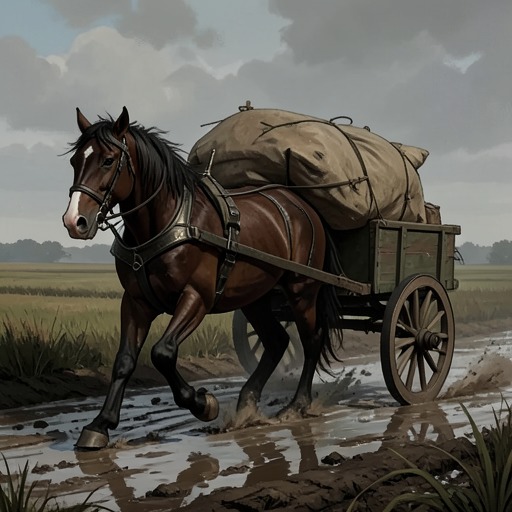
Seedy Sam Dies from Overwork
Black BeautySeedy Sam dies after describing how the economics of London cab work keep him on the road for punishing hours and leave him unable to give either himself or his horse adequate rest. Black Beauty’s account connects his death to a cycle of high rental charges, low fares, and relentless work, while showing that the pressure falls on people and animals together. The Governor’s response turns Sam’s death into a warning about conditions that extend beyond one driver or one horse.
The conditions behind Sam’s account
Black Beauty explains that many cab horses belong to large owners, who rent them to drivers for a daily sum. Because the drivers do not own the horses, they have to earn enough first to meet the owner’s charge and then to support themselves. The arrangement makes the horse’s daily earnings a matter of immediate survival for the driver, even when the animal is already tired. Black Beauty contrasts this arrangement with his own comparatively secure position under Jerry Barker, who owns both his cab and his horse and therefore has an interest in treating the horse well.
The burden becomes concrete when Sam explains the cost of hiring a cab and two horses during the season: eighteen shillings a day, or nine shillings to be earned from each horse before the driver can begin earning for himself. He says he has six children, only one of whom earns money, and that he has been on the stand for fourteen or sixteen hours a day. He has gone ten or twelve weeks without a Sunday off, and has pawned his clock to pay Nicholas Skinner. These details show that the strain is not simply a matter of a careless driver choosing to work too long: Sam describes a household dependent on his earnings and a debt that must be met before he can keep what he makes.
The fare rules compound that pressure. Within the four-mile radius, a cabman cannot charge more than sixpence for each mile after the first. Sam recounts a six-mile journey that earned him three shillings, followed by the empty journey back. On another trip, passengers’ luggage fills the cab and heavy boxes are carried on top, yet the fare for that portion is only one shilling and sixpence; a return fare adds one shilling. His accounting brings the horse’s work and the driver’s narrow margin into the same frame: miles accumulate whether or not they produce enough income to meet the day’s fixed charge.
The confrontation at the stand
The immediate discussion begins when Sam arrives with a horse that looks badly exhausted. The Governor tells him that he and the horse seem more suited to a police station than to the cab rank. Sam answers that the pressure should also be traced to the masters who charge so much and to fares set so low. He does not deny the horse’s hardship. Instead, he argues that drivers who cannot meet the daily payment may be unable to stop working without putting their own families at risk.
Sam also describes the unequal terms of the work. Drivers with their own horses and cabs, or with generous employers, have more opportunity to work humanely. Those without that security have little control over the hours, the income, or the rest available to either person or horse. He says that when the animal is thoroughly tired, the whip may be used to keep it moving. His account does not excuse the harm to the horse; it explains how financial pressure can push a driver toward conduct that harms the animal he depends on.
The other drivers gathered around Sam agree with his description of the hardship. Jerry Barker says nothing during the exchange, but Black Beauty notices that he looks unusually sad. The Governor, who had begun by blaming Sam, acknowledges that Sam’s account is true and withdraws his rebuke. He recognizes that the hardship reaches both driver and horse, and urges Sam to show the animal that he regrets taking the strain out on it. The conversation shifts from accusation to a recognition that individual kindness cannot by itself remove the pressures shaping the work.
Illness and death
A few mornings after the conversation, a different man appears with Sam’s cab. He explains that Sam became ill in the yard the previous night and could scarcely make his way home. Sam’s wife has sent a boy to say that he is in a high fever and cannot come out, so the replacement driver has taken his place. The cab’s return to the stand makes Sam’s sudden absence visible through the work he can no longer do.
The following morning, the replacement driver reports that Sam has died. He says Sam died at four o’clock, after spending the previous day delirious about Skinner and the fact that he had been given no Sundays. Even in the report of his final hours, the account returns to the rest he had said was denied him. The narration supplies no medical diagnosis establishing a precise cause of death; its sequence instead places the fever and death immediately after Sam’s account of prolonged work, financial pressure, and weeks without a day off.
For a while, no one at the stand speaks. The Governor then calls Sam’s death a warning to the other men. The pause matters: the loss is not presented as a convenient resolution to the disagreement, but as a sobering outcome that leaves the conditions Sam described in place. His death gives those conditions a human consequence without suggesting that the cabmen have suddenly gained the power to change them.
The warning’s wider significance
Sam’s story is not an isolated illustration of cab work. Later, Black Beauty finds himself working for Nicholas Skinner, whom he believes was Sam’s employer. In Skinner’s service there is no Sunday rest, and Black Beauty describes being taken on long journeys in hot weather without passengers getting down to walk up steep hills. The recurrence connects Sam’s testimony to Black Beauty’s own experience: the same lack of rest and pressure to keep earning can be imposed on a horse even when the driver is also working under harsh conditions.
The contrast with Black Beauty’s earlier life under Jerry Barker makes the consequences of ownership and working arrangements especially clear. With Jerry, Black Beauty remembers regular rest and care; under Skinner, both driver and horse are subject to harder demands. Sam’s death therefore does more than close the account of one cabman. It reveals how a system organized around daily payments and inadequate fares can exhaust the people who operate it and the animals whose labor supports it. The Governor’s warning recognizes the danger, but the episode ends without a remedy, leaving the cost of the arrangement unmistakable.